
We are living in the information generation. There has never been so much knowledge available to us on just about everything and in so many formats. However, we are huge fans of books and libraries. My daughter had some book recommendations for me that I want to share here.
Back in the 80s and 90s, I had two books for learning about my body: the bestseller, Everywoman: A Gynaecological Guide for Life by Derek Llewellyn Jones and the classic What to Expect When You’re Expecting by Heidi Murkoff and Sharon Mazel. This book was originally published in 1984 and has gone through 5 editions. What to Expect has a website, https://www.whattoexpect.com/ and an App for tracking pregnancy, also called What to Expect, with which I am now familiar since my daughter is using the App herself.
Everywoman was a great resource for me even before I thought about being pregnant myself. It was the first time I’d seen female genitalia correctly illustrated, labeled and explained. Honestly, why do people so often say ‘vagina” when they mean “vulva”? I referred to it many times in my 20s and it give me plenty of useful information and then my husband and I started our family.
Once pregnant and living in the US, I checked out What to Expect, the book, from my local library, where they had plenty of copies and there was never a problem about renewing the title. It has sold over 17 million copies. You can probably find more than one in your local thrift store at any time. You may already know that it led to a series of books: What to Expect from your toddler, two year old and so on, which I certainly reached for as my children grew and I needed to know more.
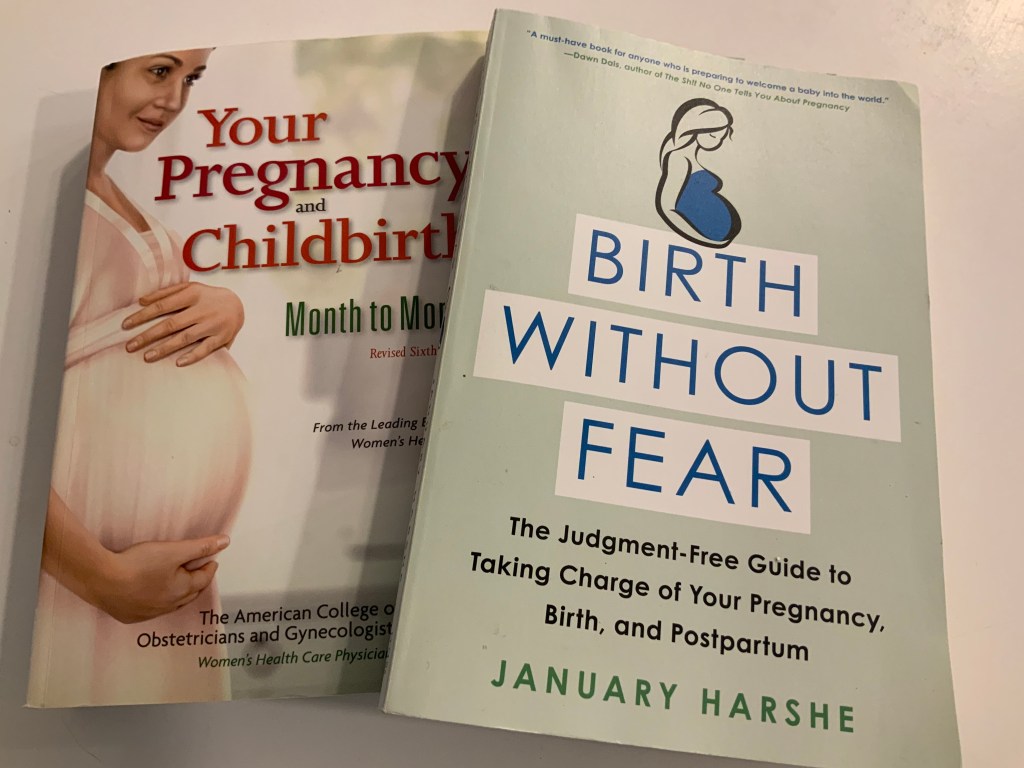
My daughter and her friends who are parents or pregnant prefer a book that first came out in 1990 and is now in a sixth edition, Your Pregnancy and Childbirth Month to Month from The American College of Obstetricians and Gynecologists, although the original title wasn’t catchy: The American College of Obstetrics and Gynecology Guide to Planning for Pregnancy Birth and Beyond. It has a very similar order to the contents as What to Expect with similar information, just a bit more in depth in places. My daughter thought it would be a good idea for me to read some of the books she was reading as a good use of our time in anticipating welcoming a new baby, and I was pleased to get on the same page as her.
Your Pregnancy and Childbirth begins with preparation for a healthy pregnancy, with advice on getting both parents in peak physical condition with special attention to nutrition. My daughter was all about the Paleo diet and making sure she filled up on good sources of protein and vegetables before reaching for the chocolate. We lived together for a while during the lockdown in the time of the pandemic and we enjoyed a lot of great home cooking with fresh ingredients. She and her husband had a good routine of personal exercise before thinking about having a baby and that only intensified with the decision to add tiny humans to their family. They were already the attentive parents of three cats.
The chapter on preparation also deals with the importance of knowing which infections “can cause birth defects or illness in a fetus. Some can also cause pregnancy complications” p.3. During Covid, the national discussion about vaccinations got very intense. However, a good strategy to protect the unborn child is to be immunized against key infections. I was interested to learn that some vaccines should not be administered to someone who is or may be pregnant because they are made from live vaccines, which may affect the fetus adversely. It’s so important to have these conversations with a doctor. Issues like this are why I would like to see universal health care so that all women who are pregnant or want to become pregnant can benefit from the best advice and care.
Your Pregnancy and Childbirth is a detailed reference book. It covers every aspect of pregnancy and birth, including 6 chapters on exceptional circumstances, complications and dealing with the loss of a pregnancy or the loss of a newborn. The restrictions on access to abortion are casting light on some of the extreme cases where the particular development path of the fetus leads to dangerous and tragic outcomes. These are a natural part of the biological process that most often pays off with a healthy baby, but sometimes does not. Women need proper support for every eventuality, good or bad.
Another book that my daughter wanted me to read is Birth Without Fear: The Judgment-Free Guide to Taking Charge of Your Pregnancy, Birth, and Postpartum by January Harshe. She is the mother of six children. She started the Birth Without Fear as a Facebook page in 2010 and is now on Instagram and a website for her blog Birth Without Fear.
I really appreciated several messages in this book. Firstly, what a beautiful voice for mothers to be she is. Again, I want to stress that all women need access to healthcare especially if we care about bringing life into the world. January has the good fortune to have access to healthcare and shows us how to speak up for ourselves in that world. My generation and certainly the previous generations were not empowered to do anything but follow directions. My mother was certainly neglected in her first experience of giving birth. Women were often shown much less respect than is acceptable today. I am delighted that the new generation of parents are less afraid to ask for what they want and need, January strongly encourages women to be their own advocates with the power to switch providers if necessary.
Secondly, there is an emphasis on creating a birth plan. There are plenty of resources and information in the book to help mothers and fathers come up with their perfect plan, including a template. There should be lots of copies of the plan, you never know how many shifts of nurses and doctors you will meet on the journey of labor and delivery. Everyone needs a copy. I will have a copy of my daughter’s so that I can speak from it as appropriate during the birth process. It should be discussed at prenatal appointments at least once before anything happens and it should include options for possible situations that might arise. It gives people such peace of mind to know that things have been thought through as far as possible in the unpredictable time of labor and delivery.
Thirdly, January talks about pregnancy having six “trimesters” and not three. There are three leading to birth and there are three following birth, which deserve the same care and attention as those before the birth. During these times, the baby is growing and changing very quickly. The body of the mother likewise goes through tremendous changes throughout the same eighteen to twenty months. The body doesn’t in fact return to what it was before pregnancy, but is forever changed. It does regain equilibrium though and is still, in a slightly different way, very beautiful.
We are all familiar with the pressure put on women to return to work after only a few weeks. The US is not a front runner in parental leave. Work places are required to accommodate women pumping breastmilk but it can be awkward pumping at work in less than ideal uncomfortable places. There is also the ever present pressure of conforming to ideals of beauty by “getting your body back”. This all puts unrealistic expectations on new mothers and can be somewhat unhealthy. January’s approach of compassionate patience with the body making adjustments to feed a baby, recover from birth, and learn how to nurture a body that is doing amazing things, is very welcome. I can feel my shoulders relaxing as I reflect on this wonderful acceptance of the body’s transitions.
Another challenge for women’s bodies is how difficult the monthly menstrual cycle can be on women and how often that experience is dismissed or minimized. Of course when brave men agree to experience a Period Pain Simulator , they get a real education and hopefully more respect for what women endure on a regular basis.
I love January bringing the conversation about the months after giving birth to the fore. Mothers need to care for themselves as well as the baby. I include fathers in this who also need some great self care to live through this physically demanding time.
Everyone around the new family, all of us, need to be a support system, pitching in to care for the baby and help the parents out with whatever they need. I’m looking forward to being part of what keeps sanity together and I’m glad to have updated my thinking and knowledge with these wonderful books.
 NanaKim
Leave a comment