

This is wisdom and experience from a loving family member who has given permission to share her words. I have edited the contents slightly to change it from a personal letter to a more general communication, that is still full of love for mothers giving birth. It may also work for other types of pain. Please let me know. This method goes beautifully with the breathing techniques we are taught at prenatal classes.
“This is a simple but useful method to get along with labour or any situation where you need to conserve your energy and stay ‘cool’. If you don’t have a standard labour it will still help enormously. If you choose to have more children later then it will stand in good stead. I had two more the straightforward way after a caesarean. Think passive about the whole thing. You are in good hands whichever way it goes and your major job is to relax. Your body knows what it is doing and so do all these amazing experts we are amongst when we give birth. They know every aspect of every event; leave it all to them. The more chilled you are, which ever route you take, the happier you and your baby will be.
Before I had children, I contemplated as to how animals do not seem to be in distress particularly when giving birth. Our analysis, conscious thought, the dramatization by many, our focus on the very, very few times this does not go well and we hear about it. We fly, we drive, we step out of our front doors, knowing that all will be well. Species wise we give birth billions of times all over the world and know that all will be well. Anything other is massively hugely unlikely and all tech is there if it ever did.
I also know from work (dentistry), that anxiety greatly lowers the sense threshold and I think is our only real obstacle. With a sustained sense of wellbeing we can do anything. Again I think that the method of relaxation here is probably what animals do naturally. It certainly feels very natural when you get it going. I’ll go through it as if you are going to do the labour thing, but as I say it is very useful for all occasions you may meet on this amazing journey. Prioritise yourself and the baby at all times and treat yourself with tender care. Whatever the occasion along the road, focus upon keeping your muscles relaxed and your mind strong but quite passive. Your birth partner will have a list of what you do and don’t want and he can be proactive for you when you are concentrating on your relaxation.
When labour begins, just the twinges, start relaxing and get into the rhythm at each small change. Use full relaxation from then on. Disconnect, move down and away for the very earliest contractions and for every single one throughout. That is your job.
Relax, move down and away, from the contraction, from everyone in the room. This is your own private smooth journey. Then come back and chat if you feel like it, or read or whatever.
A contraction has a classic shape like a sound wave and when you are feeling it happen regularly it looks like this.
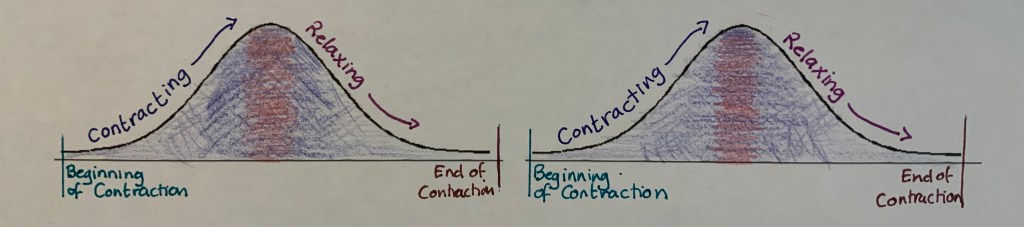
When they begin they look much much flatter than that, and are a lot further apart.
Your only task is to let this happen as your body makes a tiny adjustment each time.
In general, and throughout, let every muscle in your body go limp and comfortable. Lazily check at intervals that this is the case. Your body knows what to do so let it do its job. Gently check through your body that it is still compliant and limp.
At the very end you will need to push so save all your lovely energy and stay limp and relaxed while your body gently prepares itself.
As a contraction begins, picture it in your mind and start letting go totally. As the wave climbs let it go completely and mirror its shape in the opposite direction. As it goes up, you sink down and away from it let it go, let it go. Mirror its journey so that your course is its opposite. As you sense it reaching its high point and starting to come down, you are at your deepest point and can gently drift back up towards it at the same rate and meet it when it is back on the line.
Stay generally relaxed, particularly your back muscles. Passively sink into the mattress and again you can now have a bit of a chat with your partner or a nurse or carry on with your book.
But they must all shut up when the next contraction comes so that you can gently and fully focus going away from it downwards again, letting it go up without you. Let it go. Dissociate, your job is to gently dive down and away while it does this thing and then drift upwards towards the horizontal as it diminishes.
This has an accumulative effect and it encourages oxytocin because you can feel quite dreamy after a while, keeping to the repetitive rhythm of letting go, drifting down and relaxing. People must not talk to you or fuss you while you do this. You focus and drift and relax in your own world till you’re back on the line.
I’m sure there are people who go right through labour like this. I could get a long way in until the waves looked quite pointy and I found I needed help to ‘knock the tops off’ the waves.
Gas and air …what a boon. Like champagne with no hangover. They probably give really good instructions for it now but they did not 40 years ago. It is a fabulous analgesic but only while you are inhaling it. Because of my training I knew this. It is what makes it so safe it: does not hang around in your blood.
So You do the focused deep drifty journey as before but as you get 2/3 (or3/4 …ish whatever you find best) to the top of the contraction/ the bottom of your journey have a nice relaxed sniff and you don’t feel those ‘tops’ at all. I’d love to draw it but I don’t know how to on a computer ☺ Imagine a piece of Toblerone with no top point. You have inhaled on the left side where it is missing and exhaled on the right side where it’s missing. But the rest is the same,
Not too long after you get to this stage you will have these amazing midwives who baby you through the hard work bit. As I said the other night my brother was one of the first wave of men they allowed in at the birth in the 70s. He said “If I was decorating and it took that much effort to move the wardrobe, I’d paint round it.” You go on through, listening to the expert staff and knocking the tops off with your gas and air. Then you got your baby ☺If you do not go this route it is still amazingly useful to have this skill. I’ve done both!
Caesar babies are particuarly pretty too, if it did ever need to go that way. Not that likely but totally ok and with its own advantages.
The dissociative relaxation helps for any procedure they need to do and keeps your blood pressure down and is so good for your baby.
If you start practicing now it is really good all round for you and the baby. Check all of your muscles for limpness and go down and drift back up. It’s really pleasant…and useful. Now and for life. Do it whenever you feel like it.
Whatever route you take you will have a lovely baby at the goal post.
Stay chilled, relax, let go.”
I hope that the mother of your future grandchild will find this useful and will talk to her doctors about using it as part of her birth plan. It was very helpful for my daughter. Braxton Hicks contractions provide a good opportunity to practice ahead of time too.
 NanaKim
Leave a comment