
Music is a wonderful thing for baby development. Baby Mozart was the new way to develop baby brains to their full potential when I was a mother of young children in the 90s. I learned through my studies that music contains important information for math, rhythm and harmony and that songs of course are the best way to learn language. The rhythm and rhymes in simple songs get phrases locked in the brain with whole body learning. Vocabulary expands as the words are used in order with the emphasis of hand movements and body movements, carried along by a tune. “The wheels on the bus go round and round . . ” was a new song to me in the 90s and soon became a favorite of my children. With my own grandchild, since she is being raised speaking two languages, I want to support her Spanish learning through songs. I go directly to YouTube and find some playlists. This means that I am also learning Spanish vocabulary and sentence structure as I try to sing along. I have to admit, it took me a while to learn “Un elefante se balanceaba, sobre la tele d’un araña”. Once I learned the words, it was another thing entirely to fit them into the musical phrases, but I finally got there. My son-in-law walked in on me singing and remembered that song from his childhood. He picked up from where I left off in singing up to almost twenty elephants balancing on that spider web! I have to say that among all the Spanish songs I have got down, the Spanish language version of Baby Shark is a lot better to my ears than the English version!
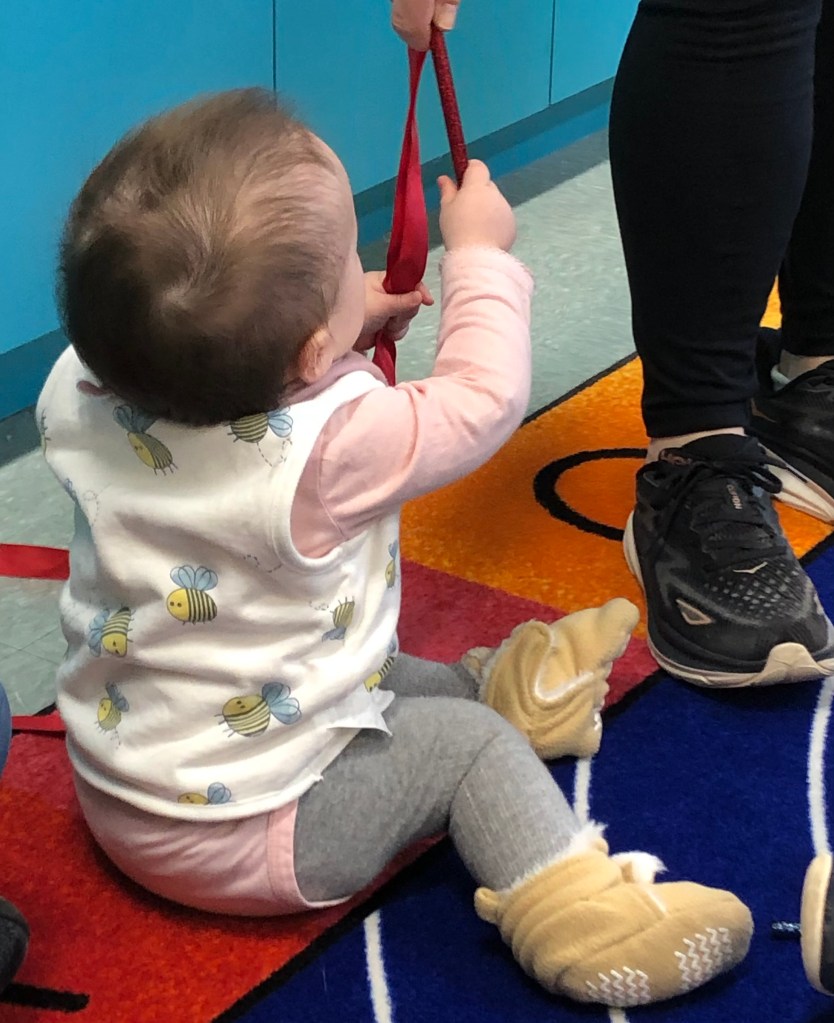
My daughter and her husband wanted our baby to start socializing in a group and they thought a music a activity would fit them bill. I found a baby music time at my local library for ages three months to two years so we started signing up for that once a week. The program consisted of a variety of simple songs with finger plays such as Skidermarink, and whole body movements such as Row, Row, Row your Boat. There were songs to go with shakers an songs to go with ribbons and a short board book story before the song of goodbye at the end. My granddaughter loved it. At first she was on my lap with me doing everything for her. Gradually, over the months as she grew physically stronger and was able to sit up more, she took over some of the movements and especially loved the shaker and waving the ribbons. The ribbon was her favorite although sometimes she spent more time chewing on the stick rather than waving the ribbon. Some songs had a lot of clapping. My granddaughter stared hard at the librarian leading the group as she clapped and didn’t she start clapping at home at around 5 months? The first time I saw her clap her hands together she startled in surprise and then smiled in delight and tried to do it again and again.
There are many programs available to bring music to little ones. We all have devices that can play music for our children. Some of us are musicians and can play music at home, you lucky people. Music is a very rich activity for children, full of cultural heritage, emotions, and social connections. But don’t forget that silence is golden and that young people also need time in silence to process everything they are experiencing. We need to balance the benefits of music with the benefits of quiet.
The baby music time at the library was a good first introduction to a class like setting with the opportunity to see and interact with other children. My granddaughter was fascinated with the crawlers and the toddlers and I think they inspired her to try out her own crawling skills. Babies liked to touch each other’s faces and shoes leading to helping them learn to touch carefully and back off when the attention was unwanted. They smiled at each other and made happy sounds of recognition when they saw each other over the weeks. I am very thankful for my local library.
What does music mean for you and your family? What are your musical memories with your own children. What songs do you enjoy with your grandchild? Are you the one that is able to take them to music time? How do your baby songs pass on your traditions and culture?
 NanaKim
Leave a comment